
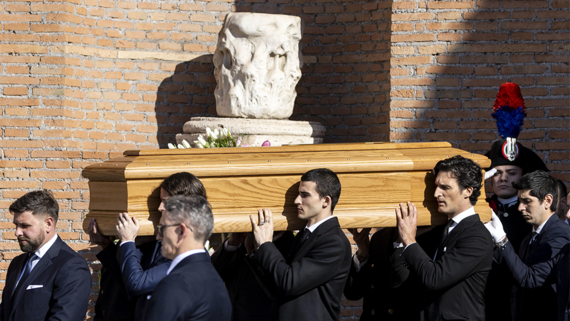
The fashion world united in grief this week as industry legends, celebrities, and devoted admirers gathered to pay their final respects to Valentino Garavani, the visionary founder of the House of Valentino who passed away at the age of 91. The funeral ceremony brought together an extraordinary assembly of fashion royalty, including Donatella Versace, Anna Wintour, Tom Ford, and numerous other icons of style, all converging to honor a man who fundamentally shaped the landscape of haute couture for over six decades.
The solemn occasion drew mourners from across the globe, reflecting the profound impact Valentino had on the international fashion community. His death marks the end of an era, as he was often referred to as the “last emperor” of fashion—a title that spoke to his regal approach to design and his unwavering commitment to glamour, elegance, and the art of making women feel extraordinary. The gathering of such prominent figures underscored not just his professional achievements but the deep personal connections he forged throughout his remarkable career.
A Legacy Written in Red
Valentino Garavani’s contribution to fashion cannot be overstated. Born in 1932 in Voghera, Italy, he founded his eponymous fashion house in Rome in 1960, quickly establishing himself as a master of romantic, feminine design. His signature “Valentino red”—a specific shade of crimson that became his trademark—dressed some of the most influential women of the 20th and 21st centuries. From Jacqueline Kennedy, who wore Valentino for her 1968 wedding to Aristotle Onassis, to modern celebrities gracing red carpets worldwide, his creations became synonymous with timeless elegance.
Throughout his career spanning nearly five decades of active design work before his retirement in 2008, Valentino created approximately 16,000 designs, each reflecting his meticulous attention to detail and his belief that fashion should celebrate femininity without compromise. His work earned him numerous accolades, including the prestigious Chevalier de la Légion d’Honneur from France, and his influence extended far beyond the runway, shaping the very definition of luxury fashion.
Fashion’s Elite Pay Tribute
The presence of Anna Wintour, the influential editor-in-chief of American Vogue, at the funeral spoke volumes about Valentino’s standing in the industry. Wintour, known for her discerning eye and powerful influence over fashion trends, had long championed Valentino’s work in the pages of her magazine. Donatella Versace, herself a titan of Italian fashion, attended to honor a peer who had helped establish Italy as a global fashion capital alongside her late brother Gianni. Tom Ford, the American designer known for his own contributions to luxury fashion at Gucci and his eponymous brand, was also among the mourners, representing the generation of designers who grew up admiring Valentino’s artistry.
The ceremony also attracted members of European aristocracy and international high society, many of whom had been personally dressed by the maestro for their most important occasions. This gathering of the fashion elite represented not merely professional courtesy but genuine affection for a man who treated his craft as an art form and his clients as muses. Valentino’s longtime business and life partner, Giancarlo Giammetti, with whom he built the fashion empire over decades, was present throughout the ceremonies, representing the personal side of a very public legacy.
The End of an Era in Haute Couture
Valentino’s passing represents more than the loss of a single designer—it symbolizes the closing chapter of a golden age in haute couture. He belonged to a generation of fashion pioneers who built their houses from the ground up, maintaining creative control and personal relationships with their clientele in ways that have become increasingly rare in today’s corporate fashion landscape. His contemporaries—Yves Saint Laurent, Hubert de Givenchy, and others—have also passed in recent years, leaving the industry transformed and perhaps less personal than the era these masters defined.
As the fashion world moves forward, Valentino’s influence will continue through the house that bears his name, now under the creative direction of designers tasked with honoring his legacy while evolving for contemporary audiences. The outpouring of tributes from designers, models, editors, and fashion lovers around the world confirms that while the last emperor may have departed, his kingdom of beauty, elegance, and uncompromising standards will endure for generations to come.
Expert Opinion: Valentino’s passing marks a pivotal moment in fashion history, as he represented the last link to an era when couturiers were true artisans who personally knew their clients and crafted each piece as a work of art. The unprecedented gathering of industry leaders at his funeral signals the fashion world’s recognition that such singular creative visions are increasingly rare in today’s market-driven industry. Future generations of designers will likely look back on Valentino’s body of work as a masterclass in maintaining artistic integrity while building a global luxury brand.