
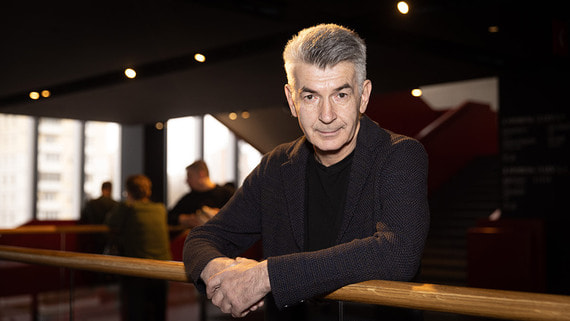
Russian writer Andrey Rubanov, known for his raw and uncompromising prose about the tumultuous 1990s in Russia, has spoken candidly about the long-awaited film adaptation of his acclaimed novel ‘The Businessman.’ The author, whose works often draw from his own dramatic life experiences including time spent in prison, reflects on how cinema has finally caught up with his literary vision. In a recent interview, Rubanov discussed not only the new film but also his literary influences, particularly the legendary Strugatsky brothers, and shared his philosophical views on forgiveness and betrayal—themes that permeate much of his work.
From Page to Screen: A Decade-Long Journey
The adaptation of ‘The Businessman’ represents the culmination of years of anticipation for both Rubanov and his readers. ‘I knew that one day this film would be made,’ the author stated with characteristic confidence. The novel, which depicts the chaotic world of Russian entrepreneurship during the wild capitalism era of the 1990s, has long been considered prime material for cinematic treatment. The story captures a period when fortunes were made and lost overnight, when the line between legitimate business and criminal enterprise was often blurred, and when survival required both cunning and moral flexibility.
Rubanov’s own biography lends extraordinary authenticity to his writing. Born in 1969, he witnessed firsthand the collapse of the Soviet Union and the emergence of a new Russia. In the 1990s, he worked in business and banking before being arrested on fraud charges in 1996. He spent several years in pre-trial detention, an experience that profoundly shaped his literary voice. His debut novel ‘Do Time, Get Time’ drew directly from this experience and established him as a unique voice in contemporary Russian literature—one unafraid to explore the darker corners of post-Soviet society.
The Strugatsky Legacy and Science Fiction Roots
During the interview, Rubanov acknowledged the profound influence of Arkady and Boris Strugatsky on his development as a writer. The Strugatsky brothers, widely regarded as the greatest Soviet science fiction writers, created works that transcended genre boundaries to offer sharp social commentary wrapped in imaginative narratives. Their novels, including ‘Roadside Picnic,’ ‘Hard to Be a God,’ and ‘Monday Starts on Saturday,’ influenced generations of Russian writers and readers. For Rubanov, the Strugatskys represented a model of how popular fiction could address serious philosophical and social questions without sacrificing narrative engagement.
This influence is evident in Rubanov’s own approach to genre. While ‘The Businessman’ is firmly rooted in realistic fiction, his other works, including ‘Chlorophilia’ and ‘Patriot,’ incorporate elements of speculative fiction and social allegory. The Strugatskys demonstrated that Russian literature could be both intellectually rigorous and accessible to broad audiences—a balance Rubanov strives to maintain in his own career. Their legacy continues to shape Russian culture, with numerous film adaptations of their works and ongoing debates about their relevance to contemporary society.
On Forgiveness and the Nature of Betrayal
Perhaps the most revealing portion of the interview concerned Rubanov’s views on forgiveness and betrayal—themes that resonate throughout his literary work. In a society that experienced the profound ruptures of Soviet collapse, where former comrades became competitors and trust became a liability, questions of loyalty and forgiveness took on existential dimensions. Rubanov’s characters often face moral dilemmas that have no clean solutions, reflecting the author’s understanding that human relationships in times of social upheaval rarely conform to simple ethical categories.
The writer’s perspective on these matters appears shaped by personal experience. Having faced betrayal during his business career and subsequent imprisonment, Rubanov brings hard-won wisdom to his exploration of these themes. His approach suggests that forgiveness is not about excusing wrongs but about freeing oneself from the prison of resentment—a metaphor particularly poignant given his own history with incarceration. This philosophical depth elevates his work beyond mere crime fiction or business thriller into the realm of serious literature that grapples with fundamental questions of human nature.
As Russian cinema continues to mine the rich material of the post-Soviet experience, adaptations like ‘The Businessman’ serve both as entertainment and as cultural memory. For audiences too young to remember the 1990s, these stories offer a window into a formative period of modern Russian history. For those who lived through it, they provide recognition and perhaps catharsis. Rubanov’s satisfaction at seeing his vision realized on screen reflects not just personal vindication but confidence that these stories remain relevant and necessary.
Expert Opinion: The adaptation of Rubanov’s work signals a maturing of Russian cinema’s engagement with its recent past, moving beyond nostalgia or condemnation toward nuanced examination. As Russia continues to process the legacy of the 1990s, literary voices like Rubanov’s serve as essential guides through that complex terrain. The success of such adaptations may encourage further exploration of this period, potentially yielding a body of work comparable to American cinema’s treatment of its own transformative eras.