
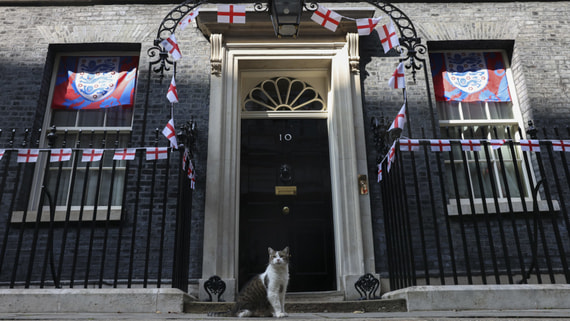
In the heart of British political power, where prime ministers rise and fall with the changing tides of democracy, one resident has maintained an unwavering presence for a decade and a half. Larry the cat, officially titled the Chief Mouser to the Cabinet Office, has served at 10 Downing Street through six different prime ministers, becoming arguably the most stable figure in British politics. While governments have collapsed, Brexit negotiations have raged, and political scandals have erupted, this tabby cat has remained steadfastly at his post, greeting world leaders and charming visitors at the famous black door.
Larry’s journey to political prominence began in January 2011 when he was adopted from Battersea Dogs and Cats Home in London. The decision to bring a cat to Downing Street was not merely sentimental—rats had been spotted near the residence, and officials determined that a feline presence was necessary to address the rodent problem. At approximately four years old at the time of his appointment, Larry was selected for his calm demeanor and reported hunting prowess, though his actual mousing abilities would later become a subject of considerable public debate and media scrutiny.
A Legacy of Feline Civil Servants
The tradition of keeping cats at government residences in Britain stretches back centuries, with records indicating that cats have been employed at the Treasury since the 1500s. The position of Chief Mouser, while not formally recognized in government records until more recently, represents a uniquely British institution that blends pragmatic pest control with national symbolism. Previous notable mousers include Humphrey, who served from 1989 to 1997 under Margaret Thatcher, John Major, and briefly Tony Blair. Humphrey’s departure from Downing Street sparked conspiracy theories and parliamentary questions, demonstrating the remarkable attachment the British public develops toward these governmental felines.
Larry’s official title grants him a certain diplomatic immunity and institutional permanence that transcends political administrations. Unlike human civil servants who might be replaced when governments change, Larry remains a constant presence, owned by the civil service rather than any individual prime minister. This arrangement ensures continuity and has allowed Larry to witness some of the most tumultuous periods in recent British political history, from the coalition government under David Cameron to the rapid succession of Conservative leaders in recent years.
Surviving Political Turbulence
The six prime ministers Larry has served alongside—David Cameron, Theresa May, Boris Johnson, Liz Truss, Rishi Sunak, and Keir Starmer—each brought their own leadership style and challenges to 10 Downing Street. Cameron initially appointed Larry, May navigated the Brexit chaos, Johnson faced the pandemic, Truss set a record for the shortest tenure, Sunak attempted to stabilize the Conservative party, and most recently Starmer returned Labour to power. Through all these transitions, Larry has maintained his duties, appearing in countless photographs with visiting dignitaries and becoming a reliable subject for journalists seeking lighter moments amid heavy political coverage.
Larry’s celebrity status has grown considerably over the years, with his own parody social media accounts accumulating hundreds of thousands of followers. These accounts, though not officially affiliated with the government, post humorous commentary on British politics from the cat’s imagined perspective. The phenomenon reflects a broader trend of anthropomorphizing political animals and demonstrates how Larry has transcended his role as a mere pest controller to become a genuine cultural icon and unofficial mascot of British democracy.
Diplomatic Duties and Daily Life
Beyond his mousing responsibilities—which various reports suggest he approaches with varying degrees of enthusiasm—Larry has become an informal diplomatic asset. Foreign leaders visiting Downing Street often pause to acknowledge the famous feline, and photographs with Larry have become sought-after moments for visiting dignitaries. His presence humanizes the often-austere atmosphere of high-level political meetings and provides journalists with reliable content during lengthy doorstep waits. Staff at Number 10 report that Larry spends his days patrolling the building, napping in prime sunny spots, and occasionally venturing into the street to interact with tourists and police officers stationed at the famous address.
As Larry enters his senior years, questions about succession planning have occasionally arisen in the British press. However, the tabby shows no signs of slowing down, continuing his daily routines with the dignified indifference that has endeared him to millions. In an era of unprecedented political volatility, Larry the cat represents something increasingly rare in British public life: stability, continuity, and an unwavering commitment to duty—even if that duty primarily involves napping in the afternoon sun and occasionally acknowledging the humans who come and go through the corridors of power.
Expert Opinion: Larry’s extraordinary tenure illustrates how symbolic figures can provide psychological continuity during periods of institutional instability. As British politics continues to experience rapid leadership turnover and constitutional debates, the Chief Mouser serves as an unexpected anchor point for national identity—a reminder that some traditions persist regardless of electoral outcomes, and that the British capacity for gentle self-deprecation through animal mascots remains a valuable diplomatic soft power asset.